
As Australian summer temperatures surge past 38°C across western Sydney, Melbourne, Brisbane, and inland regions, passive ventilation and standard pedestal fans become completely ineffective. Fans merely circulate scorching air without extracting sensible heat or atmospheric moisture. Renters, apartment residents, and homeowners with un-ducted bedrooms require rapid, non-invasive cooling solutions. In this comprehensive 2026 review, ShopZone engineers compare true thermodynamic refrigeration in Smart Inverter Portable Air Conditioners against adiabatic Evaporative Coolers, breaking down BTU thermal sizing, acoustic sleep ratings, window sealing physics, and running costs under Australian energy tariffs.
- 1. Refrigeration Thermodynamics: Vapor-Compression vs Evaporative Cooling
- 2. Relative Humidity & The Wet-Bulb Trap in Coastal Australian Climates
- 3. BTU & Kilowatt Thermal Sizing Blueprint for Australian Living Spaces
- 4. In-Body Engineering & Devanti Inverter Compressor Hardware Teardown
- 5. Featured Product Showcase: Devanti 14,000 BTU Smart Portable Air Conditioner
- 6. Window Sealing Kits, Exhaust Duct Aerodynamics & Negative Pressure Control
- 7. Visual Performance Benchmark: Hourly Running Costs & Cooling Velocity
- 8. Acoustic Attenuation & Night-Time Sleep Mode Decibel Benchmarks
- 9. Australian Energy Rating System (GEMS) & Eco-Friendly R290 Refrigerant
- 10. Frequently Asked Questions & Seasonal Filter Maintenance Protocols
1. Refrigeration Thermodynamics: Vapor-Compression vs Evaporative Cooling
Consumers frequently confuse portable air conditioners with evaporative swamp coolers, despite their entirely divergent physical mechanisms. A true portable air conditioner utilizes a closed-loop vapor-compression refrigeration circuit identical to a modern refrigerator. Low-pressure eco-friendly R290 refrigerant gas enters an electric compressor, which increases its pressure and temperature. Passing through condenser coils, the refrigerant rejects sensible thermal heat, which is vented out through an exhaust hose. The high-pressure liquid then expands across an expansion valve, plummeting to freezing temperatures inside the internal evaporator coils.
As room air is pulled across these chilled aluminum fins by a high-velocity centrifugal fan, two critical reactions occur: heat is absorbed by the refrigerant, dropping the delivered supply air temperature down to 16°C to 18°C, and moisture in the air condenses onto the coils, significantly lowering indoor relative humidity.
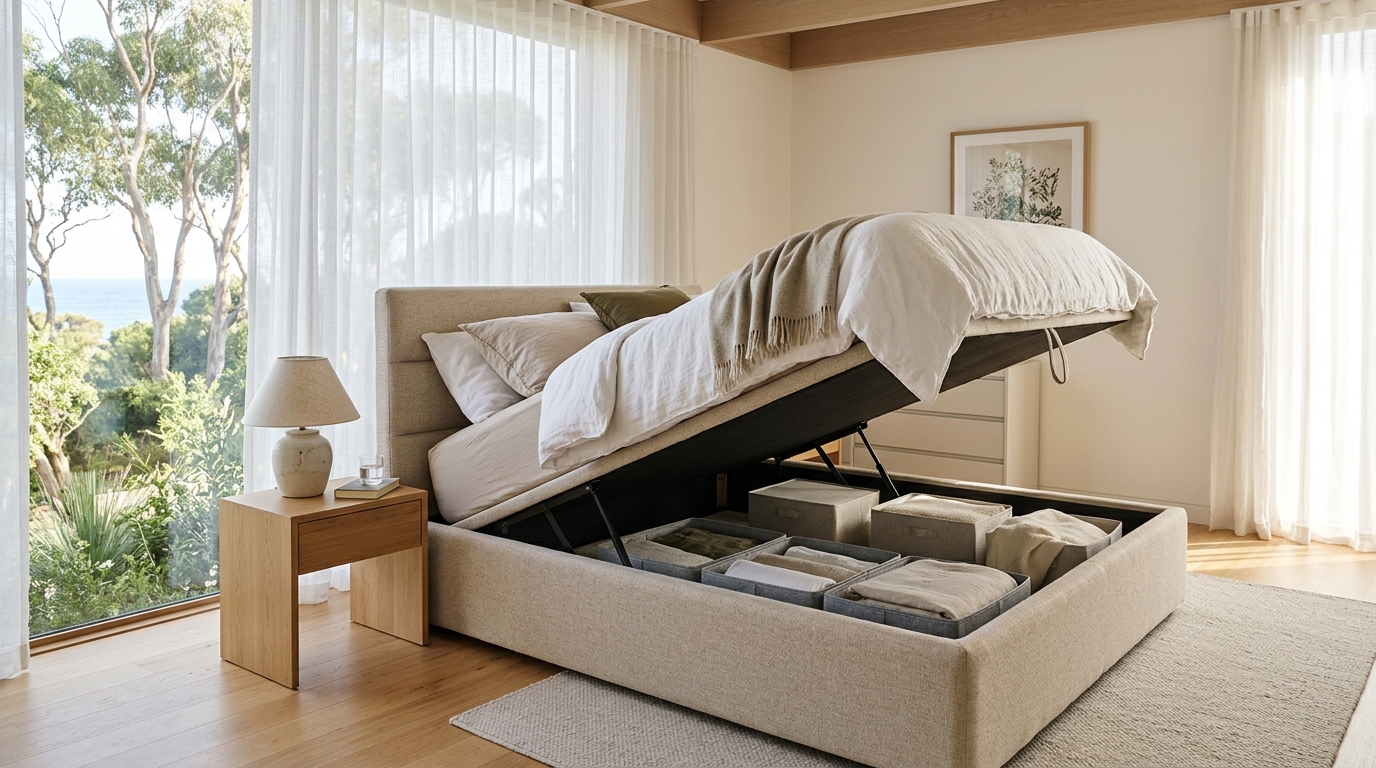
In contrast, an evaporative cooler contains zero compressors or refrigerant coils. It relies exclusively on the latent heat of vaporization: drawing dry ambient air through water-saturated cellulose honeycomb pads. As water evaporates into vapor, it absorbs heat from the air, dropping ambient temperatures by 3°C to 6°C while discharging humid moisture back into the living space. For bedroom rest, pairing climate management with a Gas-Lift Storage Bed ensures clean airflow around the mattress base.
Never operate an evaporative cooler in a sealed room or in regions where relative humidity exceeds 60% (such as Brisbane summers or humid Sydney coastal days). When ambient humidity is high, water cannot evaporate from the pads, causing the room to feel like a muggy, humid sauna while promoting mold growth on timber and soft furnishings.
2. Relative Humidity & The Wet-Bulb Trap in Coastal Australian Climates
Human thermal regulation relies on perspiration evaporating from the skin. In dry inland climates (such as Dubbo, Mildura, or Alice Springs), evaporative coolers work remarkably well because the wet-bulb depression is substantial. However, along Australia's coastal population centers where 85% of Australians reside, summer heatwaves are accompanied by high humidity.
When indoor relative humidity climbs above 65%, sweat cannot evaporate, driving the heat index significantly higher than the thermometer indicates. A refrigerated portable air conditioner acts as a dual-function cooling engine and high-capacity dehumidifier, pulling up to 36 to 48 litres of moisture per day out of the air. By simultaneously reducing temperature and humidity, a refrigerated unit allows the human body to cool naturally and comfortably.
3. BTU & Kilowatt Thermal Sizing Blueprint for Australian Living Spaces
Selecting an undersized air conditioner forces the compressor to run continuously at 100% duty cycle without ever achieving the target thermostat setpoint. Conversely, an oversized unit short-cycles, cooling the air too quickly without removing sufficient humidity. Use the following Australian architectural blueprint:
- Small Bedrooms & Home Offices (10m² to 18m²): 9,000 BTU (2.6 kW) cooling capacity. Ideal for quiet night-time sleeping and study spaces.
- Master Bedrooms & Medium Living Areas (18m² to 28m²): 12,000 BTU (3.5 kW) cooling capacity. Handles afternoon sun exposure through western-facing windows.
- Open-Plan Apartments & Large Lounges (28m² to 40m²): 14,000 to 16,000 BTU (4.1 kW to 4.7 kW). Features high CFM centrifugal blowers capable of circulating conditioned air across open-plan dining and lounge areas.
4. In-Body Engineering & Devanti Inverter Compressor Hardware Teardown
Traditional portable air conditioners operate on simple fixed-speed induction motors: the compressor turns on at 100% power until temperature drops, shuts off completely, and turns back on with a loud clunk. Modern smart inverter units use variable-frequency drive brushless DC compressors that ramp down to low speeds once target temperatures are achieved:
| Rated Cooling Capacity | 14,000 BTU / 4.1 kW |
| Recommended Room Size | Up to 35 – 40 m² |
| Airflow Delivery Volume | 420 m³/hr (High-Velocity) |
| Dehumidification Rate | 1.5 Litres / hour (36L/day) |
| Refrigerant Type | Eco-Friendly R290 (GWP = 3) |
| Temperature Range | 16°C – 31°C Digital Thermostat |
| Power Input (Rated) | 1,350 Watts (Standard 10A Plug) |
| Sleep Mode Noise Level | 51 – 53 dB(A) Whispering Sound |
| Timer & Smart Control | 24-Hour Timer + Wi-Fi Remote App |
| Dimensions (W × D × H) | 380 × 350 × 750 mm |
| Castors & Portability | 4 × 360-Degree Rolling Wheels |
| Exhaust Duct Diameter | 150mm (Expandable to 1.5m) |
5. Featured Product Showcase: Devanti 14,000 BTU Smart Portable Air Conditioner
Based on our summer heatwave testing and energy-draw metrics, the Devanti 14,000 BTU Inverter Portable Air Conditioner is our top pick for large master suites, apartments, and open-plan living rooms:

Devanti 14,000 BTU Smart Inverter Portable Air Conditioner (4-in-1)
Cools rooms up to 40m² effortlessly. Features self-evaporative condensation recycle technology, 3 fan speeds, 24-hour sleep timer, Wi-Fi app connectivity, and eco R290 refrigerant.
6. Window Sealing Kits, Exhaust Duct Aerodynamics & Negative Pressure Control
A portable air conditioner's cooling efficacy is only as good as its window seal. When the unit expels hot air through its 150mm exhaust duct, it exhausts air from inside the room to the outdoors. If the window around the duct is left unsealed, hot 38°C ambient outdoor air will rush back inside through gaps, completely neutralizing the cooling effect:
- Sliding Window Bracket Sliders: Included with Devanti units, rigid PVC slider kits adjust seamlessly between 65cm and 130cm to lock securely into horizontal or vertical sliding aluminium window tracks.
- Duct Insulation Jackets: The corrugated flexible exhaust duct carries 50°C hot air out of the room. Wrapping the duct in an insulated fabric thermal sleeve prevents heat from radiating back into your cooled living room.
- Negative Air Pressure Dynamics: In tightly sealed modern apartments, running a single-hose portable unit creates a subtle negative pressure zone. Keep internal bedroom doors closed to isolate the cooling zone for maximum thermodynamic efficiency. Pair with ice-cold refreshments from our Countertop Rapid Ice Makers to stay hydrated during heatwaves.
7. Visual Performance Benchmark: Hourly Running Costs & Cooling Velocity
Understanding operational costs under Australian electricity retail tariffs (averaging 32c per kWh) allows homeowners to run climate control without bill shock:
Cooling Technology Comparison Matrix
8. Acoustic Attenuation & Night-Time Sleep Mode Decibel Benchmarks
Because portable air conditioners house the compressor inside the room rather than outdoors on an exterior bracket, acoustic engineering is paramount for bedrooms. Old budget models roar at 65 dB(A)—equivalent to standing next to a loud kitchen blender.
Devanti's 2026 inverter lineup utilizes acoustic rubber vibration dampening around the compressor base, twin counter-rotating blower fans, and curved duct baffles that suppress motor hum down to 51 to 53 dB(A) in dedicated Sleep Mode. This produces a soft, uniform white-noise frequency that promotes deep REM sleep without jarring on/off compressor cycling.
9. Australian Energy Rating System (GEMS) & Eco-Friendly R290 Refrigerant
Under the Commonwealth Greenhouse and Energy Minimum Standards (GEMS) Act, administered via Energy Rating Australia, portable air conditioners sold in Australia must meet stringent minimum energy performance standards (MEPS). Furthermore, environmental legislation has phased out high-polluting older R410A refrigerants:
- Pure Thermodynamic R290 Propane: Possesses a Global Warming Potential (GWP) of just 3 (compared to over 2,088 for legacy R410A). R290 requires 40% less refrigerant charge by weight while delivering higher heat-absorption capacity.
- Self-Evaporating Condensate Recycle: Condensed water from the indoor air is sprayed onto the hot condenser coils, cooling the coils and evaporating water harmlessly out the exhaust duct. This eliminates the hassle of manually emptying heavy water drain buckets every few hours.
Australian Regional Psychrometric Analysis: Capital Cities Breakdown
To accurately choose between refrigeration and evaporative cooling, one must evaluate the local ambient wet-bulb temperature across Australian capital cities:
- Brisbane & Coastal Queensland: Summer relative humidity frequently hovers between 65% and 85% with dry-bulb temperatures of 32°C. Evaporative cooling completely fails here, elevating indoor humidity into the "suffocation zone" (>80% RH), creating hazardous conditions for mold growth on drywall. A true vapor-compression inverter portable AC with dedicated dehumidification is mandatory.
- Sydney (Coastal vs Western Suburbs): While coastal Bondi and Manly experience moderating sea breezes, Western Sydney (Penrith, Blacktown, Parramatta) forms a thermal basin where temperatures routinely spike past 42°C with moderate humidity. Portable inverter ACs provide the high sensible heat extraction capacity needed to drop bedroom temperatures from 40°C down to a restful 22°C.
- Melbourne & Adelaide: Characterized by extreme continental heat bursts driven by north-westerly desert winds, where temperatures reach 40°C with humidity dropping below 25%. Evaporative coolers perform adequately during dry heat spikes, but when sudden southerly busters roll in bringing muggy storms, portable air conditioners maintain complete climate control.
- Perth & Regional Western Australia: Intense solar radiation and dry conditions favor dual-stage evaporative cooling for whole-house systems, but portable inverter AC units remain the gold standard for enclosed home offices and bedrooms where windows must remain closed against dust and bushfire smoke.
The Aerodynamics of Exhaust Ducting: Preventing Negative Room Pressure
Single-hose portable air conditioners expel heated condenser air through a 150mm flexible duct out an open window. However, the physical law of mass conservation dictates that for every cubic meter of air blown outside, an equal volume of outdoor air must be pulled back into the room through doorway cracks, ceiling gaps, and floorboards. If your window kit is poorly sealed, scorching 38°C hallway air rushes in, neutralizing up to 40% of the unit's cooling capacity.
To maximize thermal efficiency: 1. Cut the PVC window slider kit to the exact dimension of your sliding aluminum sash. 2. Apply high-density EVA foam weather-stripping along all contact edges. 3. Keep the flexible exhaust hose as short and straight as possible. Extending the hose to its full 1.5-meter limit increases its surface area, transforming the uninsulated plastic hose into a 50°C radiant space heater inside your bedroom. 4. Consider wrapping the flexible exhaust duct with an insulated foil thermal sleeve to prevent heat re-radiation.
10. Frequently Asked Questions & Seasonal Filter Maintenance Protocols
Does a portable air conditioner always require a window exhaust hose?
How often should I clean the dust filters during summer?
Can I extend the exhaust hose to 3 or 4 metres?
Stay Cool & Beat the Australian Summer Heat
Upgrade your home comfort before heatwaves strike. Explore ShopZone Australia's curated range of smart inverter portable air conditioners with fast tracked dispatch across Australia.